 Ali Asghar
 QUICK ANSWER
Finding the best commercial espresso machines with grinder requires balancing performance, budget, and durability. The best high-end espresso machine with a built-in grinder for most home baristas is the Breville Oracle Dual Boiler (around $2,999), thanks to its dual-boiler stability and fully automated grind-dose-tamp workflow. Budget-conscious enthusiasts should look at the Breville Oracle Jet (around $1,999). For genuine commercial deployment in cafés, hotels, or offices, the Eversys Cameo and Franke A400 deliver café-grade consistency at real service volume, typically starting between $14,000 and $23,000.
Introduction
Most best espresso machine with a grinde guides online are really beginner buying guides in disguise they cluster around $300 to $900 machines built for a single household and a light morning routine. That’s useful information, but it doesn’t answer the question a genuinely serious buyer is asking: which machines combine a professional-grade integrated grinder with the boiler stability, dosing precision, and duty cycle to perform at a high-end home, small office, or commercial level?
This guide answers that question directly. We cover two distinct buyer categories that get lumped together far too often: high-end home and prosumer machines (the Breville Oracle line, Jura’s GIGA series, Miele’s bean-to-cup range) and true commercial super-automatics built for cafés, hotels, and offices (Eversys, Franke, Schaerer, La Cimbali, and Nuova Simonelli). Each category has a different grinder engineering standard, a different price ceiling, and a different maintenance reality, and confusing the two is the single most common mistake buyers make in this space.
By the end of this article you’ll know which tier actually matches your volume and budget, how the grinder technology differs between a $2,000 home flagship and a $20,000 commercial unit, and what the real cost of ownership looks like once beans, filters, descaling, and service contracts enter the picture. If you are deciding between a hands-on manual setup or a push-button automatic system for your workspace, check our manual vs automatic espresso machines guide before committing to a commercial unit.”
Full Comparison Table
Use this table to compare grinder type, price tier, and ideal use case at a glance before reading the buying guide below.
| Machine | Category | Grinder | Best For |
| Breville Oracle Dual Boiler | Home / Prosumer | Baratza M2 conical steel | Best overall home flagship |
| Breville Oracle Jet | Home / Prosumer | Baratza M2 conical steel | Easiest high-end entry |
| Miele CM-Series | Home / Prosumer | Single conical steel burr | Budget-friendly high-end pick |
| Jura GIGA 10 | Home / Office flagship | Dual ceramic flat-burr P.R.G. | Multi-user households & offices |
| La Cimbali (entry model) | Light Commercial | Integrated commercial grinder | Best value for real commercial internals |
| Nuova Simonelli | Commercial | Integrated commercial grinder | Mid-volume café service |
| Schaerer Ambiente | Commercial | Integrated commercial grinder | Full café or hotel service |
| Franke A400 | Commercial | Integrated commercial grinder | Office or smaller café |
| Eversys Cameo | Commercial | Integrated grinder + ETC profiling | Hotel or high-volume office |
| Franke A1000 FLEX | Commercial flagship | Dual grinder, twin-spout | Peak-volume commercial service |
| Eversys Enigma X-Wide | Commercial flagship | Dual integrated grinders | Airports & large hospitality |
What Makes an Espresso Machine “High-End” or “Commercial”?
A machine earns “high-end” or “commercial” status through engineering, not price alone. Four factors separate this tier from entry-level grind-and-brew machines:
- Grinder quality and consistency: Commercial-grade burr sets (whether Baratza-engineered conical steel burrs, ceramic flat burrs, or purpose-built commercial grinding units) hold their calibration across thousands of doses instead of dozens.
- Boiler architecture: Dual-boiler or multi-boiler designs let a machine brew and steam simultaneously without a temperature recovery penalty, which matters enormously the moment you’re serving more than one drink at a time.
- Duty cycle: A prosumer machine is rated for maybe 10 to 30 drinks a day. A true commercial unit like an Eversys or Franke is engineered for hundreds of drinks daily without component fatigue.
- Serviceability and support: Commercial buyers need a dealer network, spare parts availability, and often a maintenance contract something that barely factors into a home-machine purchase decision.
Where the line blurs is in what the industry calls the “prosumer” tier machines like the Breville Oracle Dual Boiler or Jura GIGA 10 that borrow commercial engineering concepts (auto-dosing, PID temperature control, dual boilers) but are still built and warrantied for household use. We’ve included this tier because it’s exactly where most readers searching for a “high-end” machine actually end up buying. To understand how top-tier manufacturers compare in thermal stability and durability, read our breakdown of the best espresso machine brands.
How We Evaluated These Machines
Every machine in this guide was assessed against the same criteria: grinder engineering and burr type, boiler configuration and temperature stability, automation quality (dosing, tamping, milk texturing where applicable), verified current pricing from manufacturer and authorized-dealer listings, duty cycle and intended use case, and real-world reliability signals pulled from long-term owner and technician feedback rather than first-week impressions. Pricing was checked against manufacturer and authorized dealer listings; commercial equipment pricing varies by configuration, milk system, and financing terms, so treat every figure here as a starting reference point and confirm current pricing with a dealer before purchasing.
Top 5 Commercial Espresso Machines with Grinder
These five machines represent the strongest options for a serious home user, small office, or boutique setting where full commercial equipment would be overkill.
1. Best Overall: Breville Oracle Dual Boiler
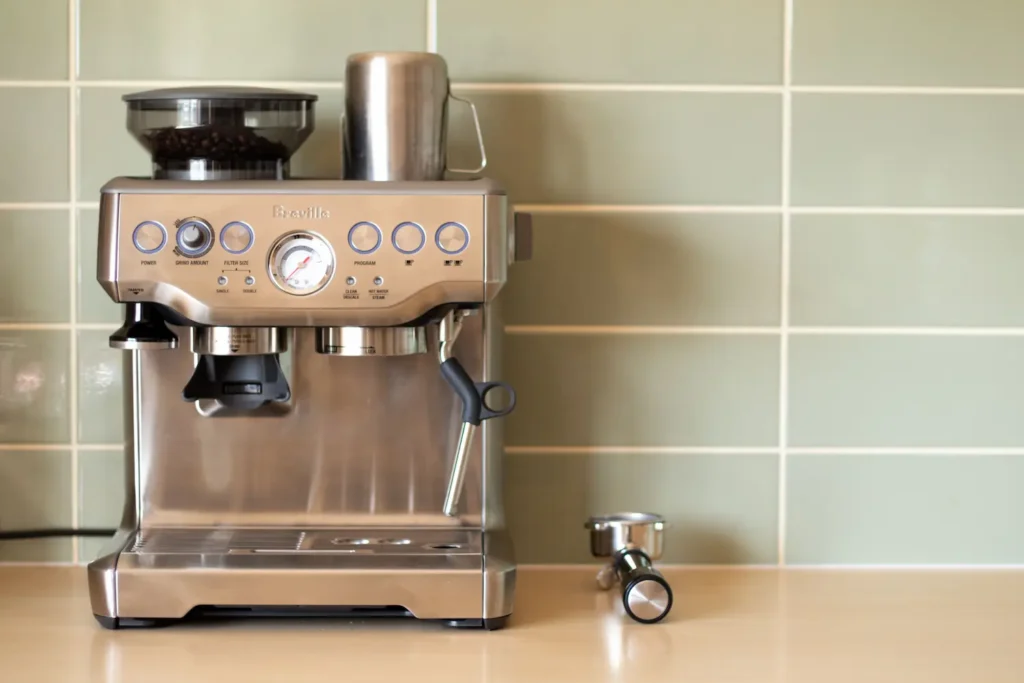
Launched in September 2025 as the successor to the discontinued Oracle Touch, the Oracle Dual Boiler is Breville’s most capable home machine to date. It pairs a 450ml PID-controlled brew boiler with a 950ml steam boiler, so it brews and steams at the same time without the temperature dip that plagues single-boiler machines. The integrated grinder uses Baratza’s M2 burr set with 45 digital grind settings plus 10 inner-burr micro-adjustments, and the machine automates grinding, dosing, and tamping into a proper 58mm portafilter the same format used on commercial equipment.For smaller office spaces or entry-level setups, explore our comparison on Breville Bambino vs Bambino Plus to see if a compact unit meets your daily output needs.
- Features: Dual PID boilers, 58mm portafilter with splitter, auto grind-dose-tamp, 5.7-inch touchscreen with manual and automatic modes
- Price: Around $2,999
- Pros: True simultaneous brew-and-steam, restaurant-grade portafilter size, both guided and full manual control
- Cons: Large footprint, steep price for a home machine, grinder dial-in can take several shots when switching bean origins
- Best for: Serious home baristas and small offices who want commercial-style control without buying commercial equipment
2. Best for High-End Beginners: Breville Oracle Jet
The Oracle Jet trades the dual-boiler system for Breville’s ThermoJet heating element, which reaches brew temperature in seconds rather than minutes. That single change lowers the price by roughly $1,000 compared to the Dual Boiler while keeping the same overhauled Baratza M2 grinder, 58mm portafilter, and touchscreen guidance. It’s the easier machine to live with day to day, at the cost of not being able to brew and steam at the exact same moment.Brands like Breville, Jura, and La Marzocco lead the commercial coffee market.
- Features: ThermoJet fast heat-up, Baratza M2 burrs, Auto MilQ milk texturing, true cold-brew and cold-extraction espresso modes
- Price: Around $1,999
- Pros: Near-instant heat-up, meaningfully lower price than the Dual Boiler, same grinder quality
- Cons: No true simultaneous brew-and-steam, still a large countertop footprint
- Best for: Buyers who want Oracle-level automation and grind quality without the Dual Boiler’s price or learning curve
3. Best Value for Money: La Cimbali Entry Super-Automatic
For buyers who need genuinely commercial internals a commercial-duty grinder, continuous-use boiler, and NSF-rated components without paying flagship commercial pricing, La Cimbali’s entry-level super-automatic lineup is the strongest value in this guide. Listed pricing on entry configurations starts around $4,770, which undercuts nearly every other true commercial option by thousands of dollars while still offering an integrated commercial-grade grinder and a duty cycle built for continuous small-office or boutique café use.
- Features: Integrated commercial grinder, continuous-duty boiler, compact commercial footprint
- Price: From around $4,770
- Pros: True commercial internals at a fraction of flagship commercial pricing, established Italian manufacturer with wide parts availability
- Cons: Fewer smart features than Jura or Eversys, configuration options add cost quickly
- Best for: Small offices, boutique retail counters, and buyers who’ve outgrown a prosumer machine but don’t need Eversys-level throughput
4. Premium Choice: Jura GIGA 10
The GIGA 10 is Jura’s flagship, and it’s the only machine in this guide with two independent grinders a pair of Professional Rotary Grinders (P.R.G.) using ceramic flat burrs, one per bean hopper. That means a household or office can run regular and decaf, or two different roast profiles, without ever swapping beans. It also brews hot and cold specialty drinks from the same panoramic touchscreen interface and carries a professional trim level aimed squarely at office and light-commercial placement.
- Features: Dual ceramic flat-burr P.R.G. grinders, Panorama Coffee Panel touchscreen, hot and cold extraction, RFID water filtration tracking, smartphone and Wi-Fi connectivity
- Price: Around $5,499
- Pros: Dual-grinder flexibility, genuinely broad drink menu, minimal daily user intervention
- Cons: Highest price of the home/prosumer tier, less manual control than the Breville Oracle line for enthusiasts who want to tinker
- Best for: Multi-drinker households, executive offices, and small breakrooms that want zero-friction variety
5. Budget-Friendly Choice: Miele CM-Series Bean-to-Cup
Miele’s CM-series is the most affordable true entry point into this high-end category, typically priced from around $2,299. It uses a single stainless-steel conical burr grinder rather than the dual ceramic setup on the GIGA 10, but the tradeoff comes with Miele’s build quality and a removable brew group that simplifies cleaning a detail hobbyist machines in this price range often skip.
- Features: Stainless steel conical burr grinder, removable brew group, one-touch specialty drink menu
- Price: Around $2,299
- Pros: Lowest entry price in the high-end tier, excellent build quality, easy-clean brew group
- Cons: Single grinder only, fewer specialty drink options than Jura’s flagship
- Best for: Buyers who want high-end reliability without paying flagship prices
True Commercial Super-Automatics for Cafés, Hotels & Offices
This is the segment almost every other “best espresso machine with grinder” article skips entirely and it’s exactly what a buyer researching commercial equipment actually needs. These machines are engineered for continuous daily output measured in hundreds of drinks, not dozens, and they’re priced and supported accordingly.
Eversys: Built for Volume and Remote Monitoring
Eversys, a Swiss manufacturer now part of the De’Longhi Group, builds commercial super-automatics for hotels, airports, corporate campuses, and high-volume cafés. Every machine uses Extraction Time Control (ETC) to profile pressure shot by shot for repeatable quality at scale, and every unit ships with e’Connect remote monitoring built in, letting operators track machine health, extraction data, and service alerts across multiple locations from one dashboard.
- Eversys Cameo (C’2s/Classic): Compact single-group entry point for offices and smaller cafés, priced from about $21,280 to $23,700
- Eversys Enigma X-Wide: Dual-station flagship built for peak breakfast service and multi-position commercial environments, priced from about $42,860 to $45,050
- Best for: Hotel chains, airport lounges, corporate campuses, and multi-location operators who need centralized monitoring
Franke: The Modular Commercial Standard
Franke’s commercial super-automatic lineup spans a wide range of configurations, from the compact single-spout A400 through the modular twin-spout A1000 FLEX. Franke machines are a common sight in office coffee programs, hotel lobbies, and mid-to-large café operations where consistent output matters more than barista showmanship.
- Franke A400: Compact single-spout model suited to offices and smaller locations, priced around $14,278
- Franke A1000 FLEX: Modular twin-spout flagship for peak-volume service, priced around $25,855
- Best for: Office coffee programs and hotel or restaurant operations that need modular configuration options
Schaerer, La Cimbali & Nuova Simonelli: The Broader Commercial Field
Beyond Eversys and Franke, three additional manufacturers round out the commercial super-automatic field. Schaerer’s Ambiente line is a well-established commercial workhorse, typically priced around $14,890 for current models, with the older Ambiente 15 SO occasionally available on the secondary market for roughly $3,000 as used equipment. Nuova Simonelli’s commercial super-automatics start from about $9,900, and La Cimbali’s broader commercial range spans from its entry model near $4,770 up past $10,530 depending on configuration.
- Schaerer Ambiente: Full commercial-duty machine with built-in grinder and hot water faucet, from about $14,890
- Nuova Simonelli: Commercial super-automatics from about $9,900
- La Cimbali: Broader commercial range from about $4,770 to $10,530+ depending on configuration
- Best for: Independent café owners and equipment buyers comparing multiple commercial brands before committing to a service contract
How to Choose the Right Machine for Your Situation
The single biggest mistake buyers make in this category is shopping by budget alone instead of matching the machine to actual drink volume. Work through these factors in order.
Match the Machine to Your Daily Volume
A Breville Oracle Dual Boiler or Jura GIGA 10 is rated for household or light-office use realistically 10 to 40 drinks a day. Push a prosumer machine past that volume consistently and you’ll see accelerated wear on the grinder motor, brew group, and pump long before a commercial unit would show the same strain. If you’re outfitting a café, a hotel breakfast station, or an office serving more than 50 drinks a day, start your search in the true commercial section of this guide, not the home/prosumer section.
Understand Grinder Type: Conical Steel vs. Ceramic Flat Burr
Conical steel burrs (like the Baratza M2 sets in the Breville Oracle line) tend to produce a slightly more forgiving grind curve and are generally easier to clean. Ceramic flat burrs (like Jura’s P.R.G. units) run cooler over long sessions and resist wear from oily beans slightly better, but they’re typically pricier to replace. Neither is objectively superior the right choice depends on how often you’ll switch bean origins and how the machine will be cleaned and maintained.
Boiler Configuration Matters More Than Marketing Suggests
Dual-boiler machines like the Oracle Dual Boiler can brew and steam simultaneously, which is essential the moment more than one drink is being made at a time a real consideration for offices and small cafés. Single-boiler or ThermoJet-style machines like the Oracle Jet are faster to heat up but ask users to brew and steam sequentially. For any setting with more than one regular drinker, prioritize dual-boiler or commercial multi-boiler architecture.
Factor In Service, Support, and Water Plumbing
Commercial machines from Eversys, Franke, and Schaerer are typically sold through authorized dealers who also provide installation, water-line plumbing, and ongoing service contracts factor that relationship into your decision as much as the sticker price. Home and prosumer machines are plug-and-fill, but even at that tier, a dedicated water filtration setup will meaningfully extend the life of the boiler and grinder.
Step-by-Step: Dialing In a Built-In Grinder
Every new machine in this guide needs a proper dial-in period before it produces its best shots. Follow this sequence whenever you switch bean origins or roast levels.
- Start with a mid-range grind setting rather than the extremes, and run two or three purge shots to clear out any leftover grounds from a previous bean type.
- Weigh your dose. Most high-end machines target 18 to 20 grams for a double shot in a 58mm portafilter confirm the manufacturer’s recommended dose and set your machine’s timed or weight-based dosing to match.
- Pull a test shot and time the extraction. A typical double espresso should run 25 to 32 seconds from the first drop to a 36 to 40 gram yield, though ratios vary by bean and roast.
- If the shot runs too fast and tastes sour or thin, tighten the grind one or two settings. If it runs too slow and tastes bitter or over-extracted, open the grind slightly.
- Re-test after each adjustment rather than making multiple changes at once grinder response isn’t always linear, especially on stepless or micro-adjustable burr sets.
- Once dialed in, log the grind setting and dose for that specific bean so you can return to it instantly next time you buy the same coffee.
Expert Tips
- Give a brand-new grinder a short break-in period the first several hundred grams of beans through a fresh burr set can taste slightly inconsistent as the burrs season.
- Humidity changes grind behavior more than most owners expect. If your shots suddenly run faster or slower with no other changes, check whether ambient humidity has shifted before assuming the grinder needs recalibration.
- On any machine with remote monitoring (Eversys e’Connect, Jura’s app connectivity), actually use the dashboard it flags grinder burr wear and descaling needs before they become a service call.
- For any commercial installation, negotiate the service contract terms before finalizing the equipment purchase, not after response time commitments matter enormously when a machine is central to daily revenue.
- Oily dark-roast beans clog conical steel burrs faster than lighter roasts. If your bean program leans dark, plan for more frequent grinder cleaning cycles regardless of machine tier.
Common Mistakes to Avoid
- Buying commercial-tier equipment for home volume. A machine rated for hundreds of drinks a day is unnecessary expense and complexity for a household of four the Oracle Dual Boiler or Jura GIGA 10 covers that volume comfortably.
- Buying prosumer equipment for commercial volume. The inverse mistake is more costly: running a home-tier machine past its rated duty cycle leads to premature grinder and pump failure, often voiding the warranty in the process.
- Skipping water filtration. Both home and commercial machines are vulnerable to scale buildup, which damages boilers and clogs grinders’ internal chutes over time. A filtration line is not optional at this price tier.
- Ignoring the total cost of ownership. Beans, water filters, descaling solution, and burr replacement add up, and commercial buyers in particular should also budget for a service contract rather than treating the sticker price as the full cost.
- Choosing a grinder burr type based on price alone. A cheaper conical burr set that clogs constantly on your specific bean program will cost more in downtime and cleaning time than a pricier, better-suited option.
Total Cost of Ownership & Maintenance
The purchase price is only the starting point. For home and prosumer machines, budget for a water filtration cartridge (typically replaced every two to three months), periodic descaling solution, and eventual burr replacement usually a multi-year interval on machines in this tier. For commercial equipment, factor in installation and water-line plumbing, a service contract (often billed annually or per visit), and a higher-volume consumables budget for filters and descaling agents given the drink count these machines handle daily. Commercial dealers like the ones supplying Eversys, Franke, and Schaerer equipment typically include installation and an initial service period in the sale confirm exactly what’s covered before signing.
Frequently Asked Questions.
Who Makes the Best Espresso Machine with Grinder?
Top commercial and high-end brands like Eversys, Franke, Jura, and La Marzocco make the best espresso machines with integrated grinders for high-volume commercial use. For semi-commercial, office, or premium home setups, Breville (Oracle Dual Boiler) is widely considered the best all-in-one option for value and performance.
How Much Does a Commercial Grade Espresso Machine Cost?
EA commercial grade espresso machine typically costs between $2,000 and $25,000+. Entry-level commercial models range from $2,000 to $5,000, mid-range machines for medium cafes cost between $5,000 and $12,000, while high-volume super-automatic units (like Eversys or Franke) cost between $15,000 and $30,000.1000).
Is Breville or DeLonghi better for espresso?
Breville is generally better for espresso enthusiasts who want superior shot extraction, precise digital temperature control (PID), commercial-style 58mm portafilters, and powerful steam wands. DeLonghi is better for budget-conscious buyers seeking compact, entry-level, or fully automatic machines that prioritize fast convenience over manual control.
What is the best commercial espresso machine?
The Eversys Cameo and Franke A1000 are considered the best super-automatic commercial espresso machines for extreme consistency and speed. If you prefer a traditional manual espresso machine for a cafe, the La Marzocco Linea PB is the industry standard for durability, shot precision, and heavy daily workflow.
Final Verdict
If you’re buying for a household or a small office, the Breville Oracle Dual Boiler is the strongest all-around choice in this guide, and the Oracle Jet is the smarter pick if the price or learning curve of the Dual Boiler gives you pause. Buyers who want dual-grinder flexibility for mixed households or offices should look at the Jura GIGA 10, while the Miele CM-Series is the most sensible entry point if budget is the deciding factor within the high-end tier.
For anyone buying on behalf of an actual café, hotel, or office serving real daily volume, the decision changes entirely: La Cimbali’s entry-level commercial machines offer the best value for stepping into true commercial-duty equipment, while Franke, Schaerer, and Eversys scale up from there depending on how many drinks you’re serving and how many locations you’re managing. Whichever tier you land in, match the machine to your actual daily volume first that single decision will save more money and frustration over the life of the equipment than any individual feature comparison. Looking for alternative brewing methods for hot summer months? Take a look at our complete guide on how to choose a cold brew maker.