 Ali Asghar
 Cold brew has gone from coffee-shop specialty to everyday home ritual and the best cold brew maker for beginners removes every barrier that might otherwise stand between you and a smooth, low-acid glass of concentrate. Unlike espresso or pour-over, cold brew demands almost no technique: there’s no precise water temperature to hit, no grind-size obsession, and no risk of channelling or over-extraction. You add coarse coffee, add cold water, wait, and strain. That simplicity is exactly why it’s the perfect entry point into home coffee brewing but choosing the right device still matters enormously for taste, convenience, and how much cleanup you’ll tolerate on a Tuesday morning.
Still deciding between brewing methods? Read our complete Moka Pot vs AeroPress comparison to find out which brewer is best for your coffee style.
This guide is built on deep research across professional testing labs (America’s Test Kitchen, Food Network), consumer review aggregators, and verified owner feedback. We identify the easiest, most beginner-friendly cold brew makers available in 2026 and we explain exactly what separates a great first cold brew maker from one that will frustrate you within a week.
Advanced users may prefer one of these Best Cold Brew Coffee Makers.
Our Top Picks
1. Why Cold Brew Is the Easiest Way to Start Brewing at Home
Cold brew coffee is made through immersion: coarsely ground coffee steeps in room-temperature or cold water for 12 to 24 hours, rather than being forced through hot water in minutes. This long, gentle extraction produces a fundamentally different flavour profile than hot-brewed coffee smoother, naturally sweeter, and significantly less acidic, because the compounds responsible for bitterness and acidity (extracted efficiently by hot water) are far less soluble in cold water.
For beginners, the appeal goes beyond flavour: cold brew is nearly impossible to mess up. There’s no grind-size-to-temperature relationship to dial in as with espresso, no pour technique to master as with pour-over, and no risk of scorching or under-extracting. The only variables coffee-to-water ratio and steep time have wide tolerance ranges, meaning even a rough first attempt produces a drinkable, often delicious result.
The trade-off is patience: cold brew takes 12–24 hours to steep, versus minutes for hot brewing methods. This guide focuses on devices that make the steeping and straining process as foolproof and low-effort as possible because for a beginner, ease of use matters as much as final flavour quality.
2. What to Look for in a Beginner Cold Brew Maker
Filtration Method: Mesh, Felt, or Paper
The filter is the single most important design choice in any cold brew maker, because it determines both the clarity of your final brew and how easy cleanup will be. Fine mesh filters (used in the Takeya and many immersion brewers) are reusable, dishwasher-safe, and produce a clean cup with minimal sediment. Felt filters (the original Toddy design) produce an exceptionally clean, full-bodied brew but require more careful handling and occasional replacement. Paper filters offer the cleanest possible result but add an ongoing consumable cost and an extra disposal step.
Brewing Method: Immersion vs. Drip/Slow-Drip
Nearly all beginner-friendly cold brew makers use immersion brewing coffee grounds sit fully submerged in water for the entire steep time. This is the simplest method and what this guide focuses on. Slow-drip towers (where water drips slowly over grounds for hours) produce a different, often more complex flavour profile, but they’re slower to set up, harder to monitor, and generally unsuited to a beginner’s first cold brew experience.
Capacity and Concentrate Ratio
Most cold brew makers produce a concentrate a strong coffee base meant to be diluted with water, milk, or ice before drinking, typically at a 1:1 to 1:3 ratio. Capacity ranges from compact 16oz devices (ideal for one person, one batch every few days) to large 2-quart pitchers that yield a week’s worth of servings after dilution. Beginners should consider how often they want to brew: a smaller device means more frequent batches; a larger one means fewer but bigger time investments.
Ease of Cleanup
This is the factor most beginners underestimate before buying and the factor that most determines whether a cold brew maker becomes a daily habit or a forgotten cupboard item. Devices with wide mouths, dishwasher-safe parts, and simple twist-and-pour designs get used regularly. Devices with narrow necks, hard-to-reach filters, or components that require hand-washing with a bottle brush tend to get abandoned after the novelty wears off.
Material: Glass vs. Plastic vs. Stainless Steel
Glass pitchers (OXO, Takeya in some versions) look attractive in the fridge and don’t retain odours or stains, but are more fragile a real consideration if cleaning involves regular handling. BPA-free plastic (most Takeya models) is shatterproof and lightweight, ideal for households with kids or anyone who wants peace of mind. Stainless steel (Toddy’s container, some premium options) is the most durable but typically opaque, meaning you can’t see the brew progress.
3. The Best Cold Brew Makers for Beginners in 2026
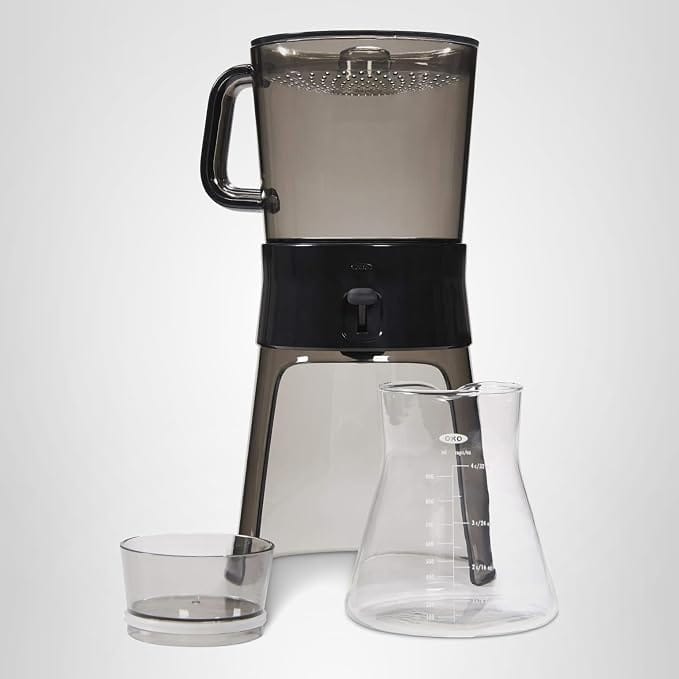
🏆 #1 — OXO Good Grips Compact Cold Brew Coffee Maker — Best for Beginners
Price: ~$45–$60 | Best For: First-time cold brewers, small kitchens, simplest setup
The OXO Good Grips Compact Cold Brew Coffee Maker is the most consistently recommended beginner pick across professional and consumer reviews and the design rationale explains why. Its signature feature, trademarked the ‘Rainmaker,’ is a perforated lid insert that distributes water evenly across the coffee grounds as you pour, ensuring every particle of coffee gets properly saturated. Even hydration is the difference between a flat, under-extracted brew and a full, balanced one and OXO automates this step so beginners don’t need to think about pouring technique at all.
The brewing process is genuinely simple: add coarsely ground coffee to the reusable stainless steel filter, place the Rainmaker lid on top, pour in cold water, and refrigerate for 12–24 hours. There’s no measuring science required beyond following the included ratio guide, and the included stainless steel filter is dishwasher-safe, removing the most tedious part of cleanup.
Reviewers note the main caveats: the device leans toward fragility (glass carafe components in some versions) and some users report occasional leaking around the lid seal. For a counter-space-conscious beginner who wants the absolute simplest path to a good first cold brew, however, the OXO remains the benchmark recommendation Food Network’s testing panel specifically praised its even extraction and called it ideal for newcomers to the format.
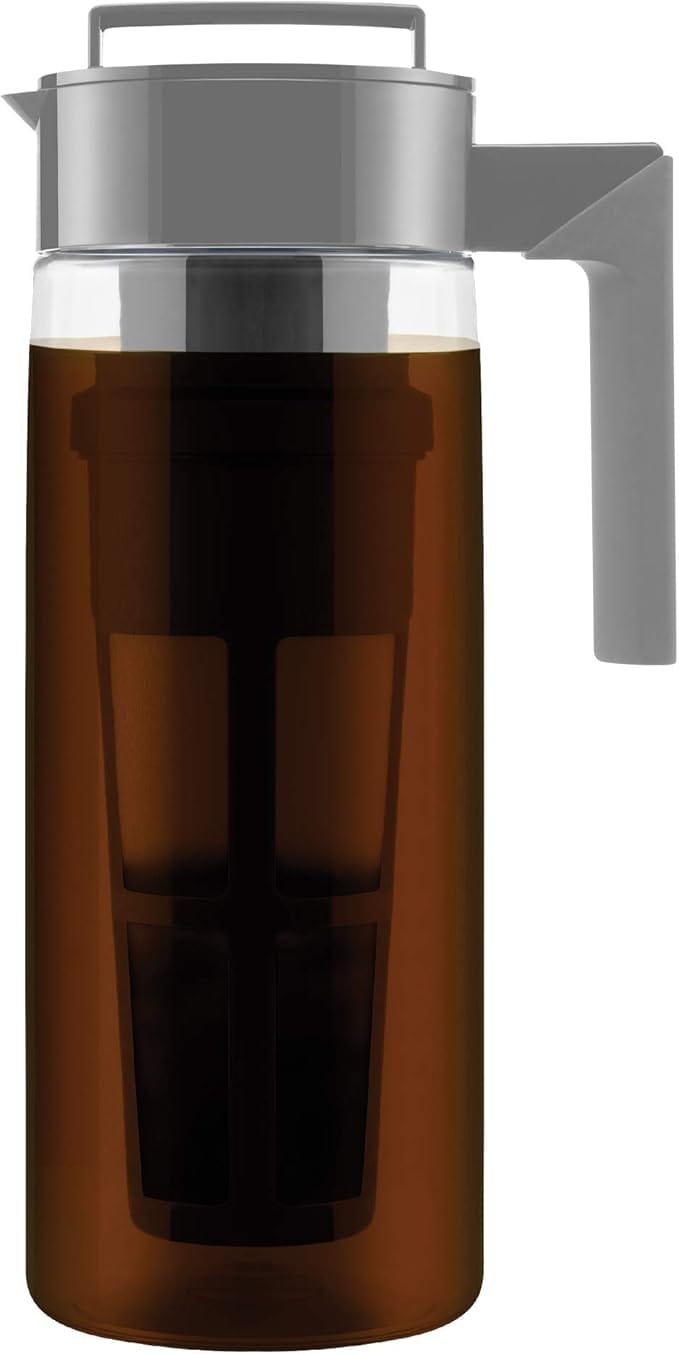
💧 #2 — Takeya Deluxe Cold Brew Maker — Best Overall Value
Price: ~$25–$35 | Best For: Households wanting maximum capacity and shatterproof durability
The Takeya Deluxe Cold Brew Coffee Maker pairs excellent everyday usability with one of the most attractive price points in this category. Its fine mesh filter is the standout feature engineered to minimise sediment passing through to the final brew, producing a notably smooth cup without the cloudiness that affects lower-quality mesh designs.
At 1-quart (32oz) capacity, the Takeya makes more concentrate per batch than the OXO, meaning fewer brewing cycles for regular drinkers. Its airtight lid is a genuinely useful feature beyond convenience: it keeps the brewed concentrate fresh in the refrigerator for up to two weeks, allowing beginners to batch-brew once and have cold brew on demand for an extended period without worrying about flavour degradation.
The BPA-free plastic construction (in most versions) makes it shatterproof a meaningful advantage for anyone who has previously dealt with a dropped glass pitcher. It’s also notably affordable, often available for under $30, which removes financial hesitation for someone testing whether cold brew will become a regular habit before investing more.
⭐ #3 — Toddy Cold Brew System — Best Flavor Quality
Price: ~$40–$50 | Best For: Beginners who prioritise the best possible flavour over speed of cleanup
The Toddy Cold Brew System has been on the market since 1977 making it the original home cold brew device and it remains the top pick in several rigorous professional testing panels, including America’s Test Kitchen, which named it their winning pick for consistently delicious, full-flavoured results.
Its dual-filtration design is the key to its superior flavour: a quarter-inch-thick food-grade polyester disk sits in the bottom of the brew basket, and the included paper filter adds a second filtration layer above it. This combination produces a notably clear, clean-tasting brew described in testing as having notes of chocolate, maple, and orange complexity that beginners might not expect from their first cold brew attempt.
The system produces approximately 40oz (1.2L) of concentrate, dilutable at a 1:2 to 1:4.6 ratio depending on preferred strength giving beginners meaningful room to experiment and find their ideal dilution without needing to rebrew. The brewing container sits atop a stand with a decanter below, and the felt or polyester filter occasionally requires patience: reviewers note it can clog and slows the decanting process, though Toddy’s inclusion of paper brew bags in newer editions has largely addressed this friction point.
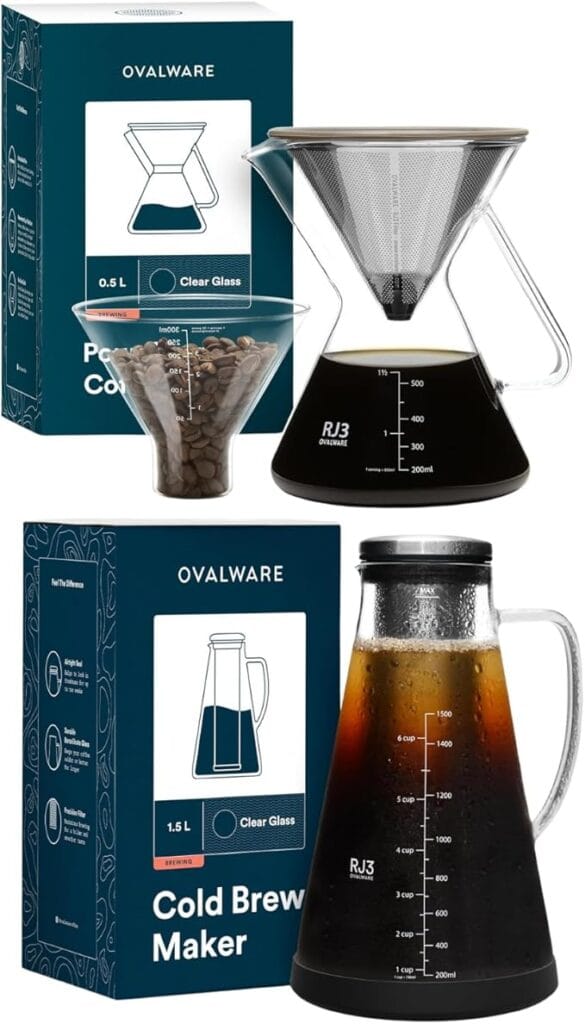
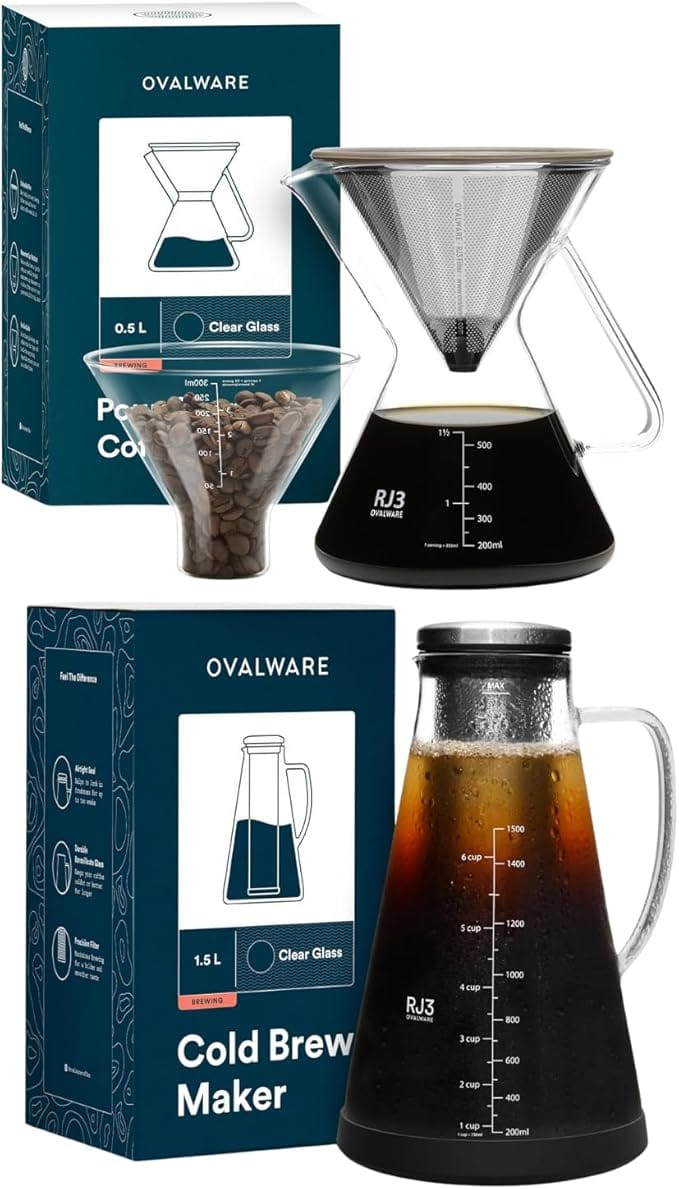
🍯 #4 — Ovalware RJ3 — Best Design & Pour Performance
Price: ~$30–$40 | Best For: Beginners who want an attractive carafe they’re happy to serve directly from
The Ovalware RJ3 ranks among the best-reviewed immersion cold brew pitchers for a specific reason: its narrow neck and wider lower brewing chamber combine to produce a notably sweet, well-rounded flavour profile testers attribute this to the relatively porous, lengthy filter design paired with the chamber geometry, which appears to extract more gently and evenly than competitors.
Design-wise, the Ovalware stands out with thoughtful, practical details: a rubber base pad that prevents sliding and protects refrigerator shelves, a reinforced lip designed to resist chipping, and an excellent grip-and-pour profile that makes serving directly from the pitcher both comfortable and attractive. It is one of the more visually pleasing cold brew makers in this price range a genuine consideration for anyone who will be pulling it out of the fridge daily and wants it to look good doing so.
The honest limitation reviewers cite: some additional decanting is recommended to remove excess sediment, and the silicone seals are described as only average quality. Cleaning requires a bottle brush for thorough hand-washing rather than being fully dishwasher-friendly. For beginners prioritising aesthetics and flavour balance over the absolute lowest-maintenance cleanup, the Ovalware remains an excellent choice.
4. Full Specification Comparison
| Spec / Feature | OXO Compact Cold Brew | Takeya Deluxe | Toddy Cold Brew System | Ovalware RJ3 |
| Price (2025) | ~$45–60 | ~$25–35 | ~$40–50 | ~$30–40 |
| Capacity | ~24 oz | 32 oz (1 qt) | ~40 oz | ~34 oz |
| Filter Type | Stainless mesh | Fine mesh | Felt + paper (dual) | Cloth/mesh |
| Material | Plastic + glass | BPA-free plastic | Plastic/steel stand | Glass |
| Dishwasher Safe | Filter only | Yes (most parts) | No (hand wash) | No (hand wash) |
| Best Flavor Trait | Even extraction | Low sediment | Complex/full-bodied | Sweet/rounded |
| Brew Time | 12–24 hrs | 12–24 hrs | 12–24 hrs | 12–24 hrs |
| Shatterproof | Partial | Yes | Mostly (steel stand) | No |
| Beginner Friendliness | Excellent | Excellent | Very Good | Good |
5. How to Make Cold Brew: A Beginner’s Step-by-Step
how to choose a cold brew maker, the fundamental cold brew process is the same. Here’s the complete beginner workflow:
Step 1: Choose the Right Grind
Always use a coarse grind similar to French press, roughly the texture of coarse sea salt. Fine grounds will clog filters and produce a muddy, over-extracted, bitter brew. If buying pre-ground coffee, look specifically for bags labelled ‘cold brew grind’ or ‘coarse grind.’
Step 2: Measure Your Ratio
A standard starting ratio is 1:4 (coffee to water) by weight for concentrate for example, 4oz (113g) of coarse coffee to 16oz (473ml) of cold or room-temperature water. This produces a strong concentrate meant to be diluted before drinking. If you prefer a ready-to-drink strength without dilution, use a 1:8 ratio instead.
Step 3: Combine and Steep
- Add the coffee grounds to your maker’s filter or basket
- Pour cold or room-temperature water over the grounds, ensuring full saturation (this is where devices like the OXO Rainmaker lid genuinely help)
- Stir gently if your device allows, to ensure no dry pockets of coffee remain
- Cover and refrigerate, or leave at room temperature, for 12–24 hours
Step 4: Strain and Store
- Remove the filter/basket once steeping is complete
- Discard the spent coffee grounds (these can be composted)
- Transfer the concentrate to an airtight container if your maker doesn’t already double as storage
- Refrigerate most concentrates stay fresh for 7–14 days depending on the device’s seal quality
Step 5: Serve
- Dilute concentrate with cold water or milk at a 1:1 to 1:3 ratio, adjusting to taste
- Serve over ice for the classic cold brew experience
- Experiment with oat milk, sweeteners, or a splash of vanilla once you’ve found your base ratio preference
6. Common Beginner Mistakes (And How to Avoid Them)
- Using a fine or medium grind: produces excessive sediment and a muddy, bitter brew. Always grind coarse, or ask your roaster/grocery store for a cold brew-specific grind.
- Steeping for too short a time: under 12 hours often produces a weak, underdeveloped flavour. Patience is the entire mechanism of cold brew don’t rush it.
- Steeping for too long: beyond 24 hours, some coffees begin to develop unwanted bitter or astringent notes, particularly with darker roasts. Set a timer.
- Skipping dilution: cold brew concentrate is intentionally strong. Drinking it undiluted will taste overwhelmingly intense and overly caffeinated for most people.
- Not pre-wetting/saturating grounds evenly: dry pockets of coffee lead to uneven extraction. This is precisely the problem devices like OXO’s Rainmaker lid are designed to solve.
- Neglecting filter cleaning: coffee oils left in mesh or felt filters go rancid and will taint future batches with off-flavours. Clean after every use.
7. Choosing Beans for Cold Brew
Medium to dark roasts generally perform best for cold brew, as their deeper flavour compounds chocolate, caramel, nutty notes extract well even at cold temperatures, while their lower acidity pairs naturally with cold brew’s already-reduced acid profile. Light roasts can work but tend to produce a thinner, less satisfying cold brew unless the brewer specifically wants to highlight bright, fruity notes.
Freshness still matters for cold brew, though slightly less critically than for espresso beans within 4–6 weeks of roast date will produce noticeably better results than older, stale coffee. Origin-wise, Brazilian, Colombian, and Sumatran beans are popular cold brew choices for their naturally chocolatey, low-acid profiles, though personal preference should always guide the final decision.
8. Final Verdict: Best Cold Brew Maker for Beginners
For most first-time cold brewers, the OXO Good Grips Compact Cold Brew Coffee Maker is the best choice. Its Rainmaker lid removes the only technique-dependent step in the entire process even water saturation making it close to foolproof for someone who has never made cold brew before. Combined with a dishwasher-safe filter and consistently smooth results in professional testing, it’s the lowest-friction entry point into home cold brew.
If budget and capacity matter most, the Takeya Deluxe delivers outstanding value a larger yield, two-week fridge life thanks to its airtight seal, and one of the most affordable price points in the category, all without sacrificing flavour quality.
And if you’re willing to trade a little extra cleanup effort for the best possible flavour, the Toddy Cold Brew System’s independently verified, decades-proven results make it hard to beat it remains the choice of professional testing panels for a reason.
Whichever maker you choose, remember that cold brew rewards patience more than precision. Use a coarse grind, stick to a 1:4 starting ratio, steep for 12–24 hours, and dilute to taste. Within your first week, you’ll have a process dialled in and a daily ritual that costs a fraction of what the same cup would cost at a coffee shop.
Who makes the best cold brew?
Commercial brands like Stōk, Chameleon Cold-Brew, and La Colombe consistently rank highest for pre-made grocery options. For home preparation, OXO and Toddy make the best cold brew systems, producing rich, low-acidity concentrates with minimal grounds escaping into the final cup.
Is a cold brew maker worth it?
Yes, if you regularly drink iced coffee. While a Mason jar or French press can make cold brew, a dedicated cold brew maker features specialized fine-mesh filters and drain switches that eliminate messy straining, reduce sediment, and save money compared to daily cafe purchases.
How much does a cold brew maker cost?
Cold brew makers vary by build and speed technology:
Budget Pitchers / Immersion Carrells: $15 to $30 (e.g., Takeya or Hario Mizudashi).
Mid-Range / Specialty Concentrators: $40 to $70 (e.g., OXO Good Grips or Toddy System).
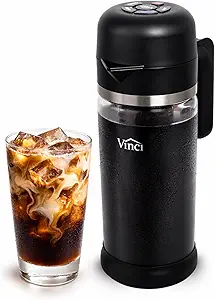
Electric / Rapid Cold Brew Machines: $100 to $150+ (e.g., Dash Rapid or Vinci).
What is the best cold coffee maker for home?
The OXO Good Grips Cold Brew Coffee Maker is widely rated as the overall best home brewer. Its signature “Rainmaker” top evenly distributes water over coffee grounds, and its simple release-switch drains clean concentrate directly into a glass carafe.
What is the best at-home cold brew maker?
Best Overall: OXO Good Grips Cold Brew Coffee Maker
Best Budget Pitcher: Takeya Deluxe Cold Brew Maker
Best Big-Batch Brewer: Toddy Cold Brew System
Best Fast-Brewing Model: Dash Rapid Cold Brew Maker (brews in 10-15 minutes)
How does cold brew differ from iced coffee?
The main difference is the brewing method and extraction temperature:
Cold Brew: Uses coarse grounds steeped in cold or room-temperature water for 12 to 24 hours. This results in a naturally sweet, low-acid, and smooth coffee.
Iced Coffee: Is hot-brewed coffee that is cooled down and served over ice. It brews in minutes but retains higher acidity and sharper bitterness.