 Ali Asghar
 Quick Answer
The ECM Synchronika is the ultimate prosumer dual-boiler machine for enthusiasts seeking German precision, quiet rotary operation, and superior manual flow control at roughly half the cost. The La Marzocco GS3 (AV or MP) is a commercial-grade power station built with legendary Italian heritage, uncompromised thermal stability, and maximum volume output for luxury home setups or small commercial cafes.
Introduction
The quest for the ultimate home espresso setup leads passionate coffee enthusiasts to a crucial decision point: choosing between high-end prosumer E61 machines and genuine commercial-grade equipment repurposed for luxury home kitchens. At the pinnacle of this intersection stand two benchmark machines: the ECM Synchronika vs La Marzocco GS3.
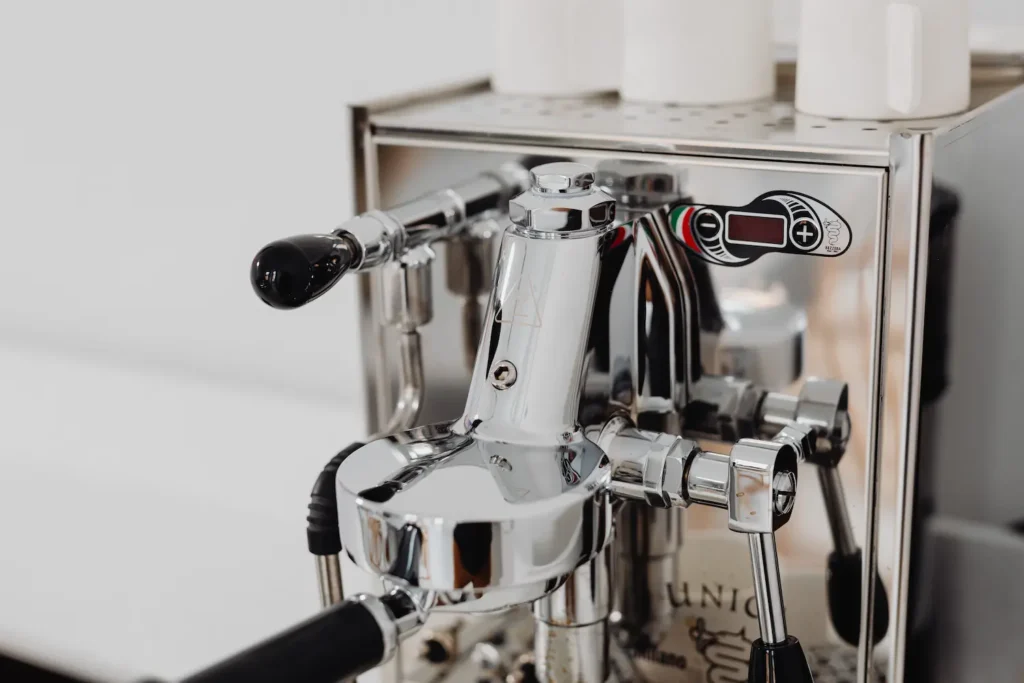
The ECM Synchronika represents the highest evolution of the classic E61 dual-boiler platform. Crafted with immaculate German engineering and wrapped in mirror-polished stainless steel or powder-coated anthracite panels, it delivers commercial-grade consistency within a residential footprint. It appeals directly to purists who appreciate tactile mechanical feedback, mechanical pre-infusion, and rock-solid thermal mass.
On the other side of the arena sits the legendary La Marzocco GS3, a machine born directly from La Marzocco’s commercial cafe lineage. Built in Florence, Italy, the GS3 packs the exact performance, saturated group architecture, and thermal stability of a high-volume commercial machine into a footprint compact enough for home counters and pop-up catering events.
In this comprehensive side-by-side analysis, we evaluate every critical dimension of these two titans: thermal dynamics, pump architecture, steam capabilities, daily workflow, long-term maintenance, and overall value. Whether you are upgrading from an entry-level dual boiler or building your dream home espresso bar, this guide provides the technical depth and practical insights needed to make an informed investment.
ECM Synchronika vs La Marzocco GS3.: Key Specifications Compared
| Feature / Specification | ECM Synchronika | La Marzocco GS3 (AV / MP) |
| Origin | Germany | Italy |
| Group Head Type | Custom E61 with Stainless Top / Flow Control Option | Commercial Saturated Group |
| Boiler Configuration | Dual Stainless Steel | Dual Stainless Steel |
| Brew Boiler Capacity | 0.75 Liters | 1.5 Liters |
| Steam Boiler Capacity | 2.0 Liters | 3.5 Liters |
| Pump Type | Commercial Rotary Vane Pump | Commercial Rotary Vane Pump |
| Water Supply | 2.8L Reservoir or Direct Water Line Plumbable | 3.5L Reservoir or Direct Water Line Plumbable |
| PID Temperature Control | Yes (Silver PID Display with Shot Timer) | Yes (Digital Display with Graphic Menu) |
| Flow / Pressure Profiling | Optional ECM Flow Control Mechanism | Manual Paddle (MP version) / Volumetric Auto (AV) |
| Warm-Up Time | ~15 to 20 Minutes | ~20 to 25 Minutes |
| Power Requirements | 110V / 15A or 20A (1400W Brew + 1400W Steam) | 110V / 15A or 20A (2100W Total Peak) |
| Weight | 35.5 kg (78.2 lbs) | 33 kg (72.7 lbs) |
| Target Audience | Enthusiasts wanting precision flow control & build quality | Connoisseurs, high-volume home entertaining, commercial catering |
Design, Build Quality, and Aesthetics
Both ECM and La Marzocco stand at the absolute pinnacle of Italian and German coffee engineering. For a broader look at how these manufacturers compare against other leading industry leaders, explore our roundup of the top espresso machine brands on the market today.
ECM Synchronika
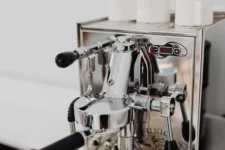
The ECM Synchronika is widely considered one of the best-built E61 machines on the market. It utilizes a heavy-gauge, single-piece stainless-steel frame with polished mirror-finish side and front panels. What sets ECM apart visually is the contrasting powder-coated anthracite (dark gray) chassis at the base, which gives the machine an exceptionally stable, modern, and grounded stance.
Every touchpoint on the Synchronika exhibits obsessive German attention to detail. The joystick-style steam and hot water valves operate smoothly, engaging instantly with a simple flick rather than tedious turn-knobs. The portafilter is balanced, ergonomically angled, and weighted to feel premium in hand.
La Marzocco GS3
The La Marzocco GS3 carries an iconic, low-profile commercial stance designed by dynamic Italian engineering teams. Its exposed saturated group head dominates the front, signaling commercial capability from the moment you look at it.
The GS3 offers extensive customization possibilities. While it comes standard with sleek stainless steel side panels and black accents, owners can customize it with real wood side panels (walnut, oak, maple), custom powder coating, brass accents, and glass side panels. Its overall presence is bolder and broader than the Synchronika, making it a central design centerpiece in modern kitchens.
Thermal Stability, Boilers, and Heating Performance
| Machine Model | Boiler & Group Head Configuration |
| ECM Synchronika | 0.75L Stainless Brew Boiler + Thermo-Siphon E61 Group Head |
| La Marzocco GS3 | 1.5L Stainless Brew Boiler + Fully Saturated Group Head |
ECM Synchronika
The Synchronika utilizes a dual stainless steel boiler design with a 0.75-liter brew boiler and a 2.0-liter steam boiler. Both boilers are insulated to maximize energy efficiency and maintain temperature retention.
Temperature management is controlled by a digital PID controller visible on the front face of the machine. The PID uses advanced algorithms to keep brew water temperatures steady within 0.5 degrees Celsius. Combined with the massive brass mass of the E61 group, the machine easily pulls consecutive shots without experiencing thermal drift.
La Marzocco GS3
The GS3 takes thermal stability to commercial levels with a 1.5-liter brew boiler connected directly to its saturated group head. In a saturated group, water circulates from the brew boiler continuously through the group head casting, ensuring the metal surrounding the shower screen is always at the exact same temperature as the water inside the boiler.
The GS3 also features a pre-heating system: incoming cold water passes through a heat exchanger inside the massive 3.5-liter steam boiler before entering the brew boiler. This means that even during back-to-back shots at maximum speed, incoming water never cools down the brew boiler. For high-volume hosting, catering, or commercial pop-ups, the GS3 offers unmatched thermal endurance.
Group Head Architecture: E61 vs. Saturated Group
| eature / Architecture | E61 Thermo-Siphon Group (Synchronika) | Saturated Group (GS3) |
| Construction | Heavy Brass Casting | Water Welded Directly to Brew Boiler Casting |
| Circulation | Thermo-Siphon Loop Circulation | Direct Boiler Saturation |
| Design Feature | Stainless Top Chamber | Zero Temperature Delta |
E61 Group (ECM Synchronika)
The E61 group head has been an industry icon since 1961 due to its natural mechanical pre-infusion chamber and thermal stability. ECM refined this design by swapping internal brass components for stainless steel to reduce scale build-up and metal wear.
The key advantage of the E61 architecture on the Synchronika is its adaptability. It easily accepts an aftermarket or factory-fitted Flow Control Device, allowing you to dial in needle-valve flow restrictions manually during the extraction process.
Saturated Group (La Marzocco GS3)
A saturated group head eliminates the distance between the boiler and the extraction chamber. The group head is welded directly to the brew boiler, filling with water to create a uniform thermal mass.
The primary advantages of a saturated group are:
- Zero temperature drop from boiler to puck.
- Extremely rapid recovery time between consecutive extractions.
- Higher consistency over 20+ back-to-back shots compared to thermo-siphon systems.
Flow Control, Pressure Profiling, and Shot Extraction
Whether you choose hands-on manual profiling or effortless push-button repeatability, matching the workflow to your daily routine is key. If you are still deciding between hands-on flow manipulation and programmatic brewing, check our detailed manual vs automatic espresso machines guide to see which style fits your daily routine best.
ECM Synchronika Flow Profiling
When equipped with the ECM Flow Control Device, the Synchronika turns into a flavor exploration engine. A stainless steel needle valve controlled by a top-mounted mushroom lever allows you to restrict or increase water flow from 0 to over 12 grams per second.
ECM Flow Control Extraction Cycle
0s ------------- 10s ------------- 25s ------------- 35s
[ Low Flow Pre-Infusion ] [ Full 9-Bar Extraction ] [ Decline Flow to End ]
This manual flow control lets you:
- Pre-Infuse Low Pressure: Saturate light roast coffees for 10–15 seconds at 2 bar pressure to prevent channeling and maximize extraction yields.
- Decline Flow: Reduce pressure toward the end of a shot to mitigate bitterness as the coffee puck degrades.
- Emulate Lever Profiles: Mimic classic spring-lever pressure curves for ultra-smooth espresso.
La Marzocco GS3 MP (Manual Paddle)
The GS3 MP utilizes a internal conical valve connected to the iconic manual paddle on top of the group head. Moving the paddle progressively opens the valve, allowing the barista to control pre-infusion and flow rate manually using line pressure or pump pressure.
The GS3 MP features a digital pressure gauge mounted directly on the group head face, providing instant feedback on real-time puck pressure. The feel of the GS3 paddle is exceptionally smooth, offering a tactile, mechanical connection to the brewing process.
La Marzocco GS3 AV (Auto-Volumetric)
The AV version ditches manual flow manipulation in favor of absolute volumetric precision. Baristas program exact water volumes down to the milliliter using internal flow meters. Pushing a single button executes identical pre-infusion and volumetric yield every single time, making it ideal for busy families or users who prioritize repeatable excellence without manual monitoring.
Steam Power and Milk Texturing
Steam Boiler Capacity Comparison
ECM Synchronika:   [ 2.0 L ] ─── (Up to 2.0 Bar Steam Pressure)
La Marzocco GS3:   [ 3.5 L ] ───(Commercial Steam Force)
ECM Synchronika
With its 2.0-liter dedicated steam boiler capable of operating up to 2.0 bar of steam pressure (adjustable via the PID interface), the Synchronika is a steaming powerhouse.
- Performance: Textures 150ml of milk for a cappuccino in roughly 12 to 15 seconds.
- Wand: Features a no-burn dual-wall stainless steel steam wand with a 2-hole tip (optional 4-hole tips available).
- Control: Joystick levers offer instant on/off engagement.
La Marzocco GS3
The GS3 operates with a massive 3.5-liter dedicated steam boiler, delivering dry commercial steam power indistinguishable from La Marzocco’s multi-group commercial machines.
- Performance: Microfoams milk for a 200ml latte in under 8 to 10 seconds with roll dynamics that create velvety texture effortlessly.
- Wand: Features La Marzocco’s Performance Touch steam wand (insulated to prevent milk baking onto the metal).
- Control: A smooth, classic turn-dial valve gives precise pressure modulation from gentle foam to full commercial force.
Usability, Interface, and Daily Workflow
ECM Synchronika Workflow
- Power Up: Machine heats up silently via rotary pump management in ~18 minutes.
- Shot Preparation: Lock in the heavy 58mm portafilter. Lift the E61 lever to start extraction.
- Timer: The silver PID display automatically switches into a digital shot timer counting seconds.
- Steaming: Flip the steam joystick outward; instant full steam pressure locks into place without holding.
- Clean Up: Simple backflush access and wide drip tray remove effortlessly without spills.
La Marzocco GS3 Workflow
- Power Up: Digital interface handles auto-on schedule settings so the machine is hot when you wake up.
- Shot Preparation: Lock in the commercial portafilter. Press a volumetric button (AV) or sweep the paddle (MP).
- Display: Real-time extraction parameter updates display on the back-lit screen.
- Steaming: Turn the heavy-duty steam valve knob for rapid dry steam rolling.
- Clean Up: Deep, high-capacity drain tray handles aggressive purges and portafilter rinses without splashing.
Plumbing, Reservoir, and Pump Operations
Both machines are equipped with commercial-grade rotary vane pumps, which are whisper-quiet compared to noisy vibratory pumps found on entry-level machines.Connecting directly to a water line provides a steady supply for back-to-back shots, but controlling mineral content remains critical for machine longevity and optimal extraction. To protect dual boilers from scale accumulation while maximizing extraction clarity, ensure your incoming supply strictly matches official SCA water quality standards for hardness, pH, and TDS.
| Machine Model | Water Source Switching Mechanism |
| ECM Synchronika | Quick switch lever under drip tray (Tank vs. Direct Plumb) |
| La Marzocco GS3 | Plumb kit included / Internal menu toggle |
- ECM Synchronika: Houses a 2.8-liter internal reservoir under a removable warming tray. Switching to direct water line plumbing is done by flipping a mechanical switch located directly under the water tank and connecting the included braided line.
- La Marzocco GS3: Uses a large 3.5-liter pull-out reservoir hidden neatly behind the lower drip tray. To plumb into main lines, install the included plumbing kit and select the water source via the digital menu interface.
Maintenance, Cleaning, and Long-Term Reliability
ECM Synchronika Maintenance
- Daily: Backflush group head with plain water; wipe down shower screen and steam wand.
- Weekly: Chemical backflush using Cafiza or equivalent E61 cleaner.
- Group Rebuilds: The E61 group uses standard, widely available brass and stainless pins, springs, and cam gaskets. Servicing can easily be performed by home mechanics with basic tools.
- Parts Availability: Extremely high; E61 parts are standardized across the industry.
La Marzocco GS3 Maintenance
- Daily: Flush group head, brush shower screen, purge and wipe steam wand.
- Weekly: Run automated backflush program through the digital menu screen using a blind basket and detergent.
- Group Rebuilds: Saturated group seals and MP conical valve O-rings require periodic replacement (typically every 12 to 24 months depending on usage).
- Parts Availability: Parts are readily available through La Marzocco’s worldwide commercial dealer and service network.
Who Should Buy What? (Buying Recommendations)
While dual-boiler powerhouses like the Synchronika and GS3 offer uncompromised commercial power, they require a substantial financial investment. If you are looking for high-quality espresso on a smaller budget before stepping up to prosumer equipment, take a look at our favorite budget espresso machines under $500.
Buy the ECM Synchronika If:
- You want maximum value for money in a top-tier prosumer setup without spending 5-figure amounts.
- You love hands-on manual flow control to experiment with light roasts, pressure profiling, and pre-infusion curves.
- You prefer the classic, timeless aesthetic of polished chrome and E61 group styling.
- You want straightforward, easy self-maintenance that you can manage at home with standard tools.
Buy the La Marzocco GS3 If:
- You demand commercial cafe performance, speed, and endurance for heavy daily use or entertaining large groups.
- You want absolute volumetric consistency (AV version) for effortless, push-button coffee perfection.
- You want the prestigious prestige, design options, and proven commercial lineage of the La Marzocco brand.
- Budget is secondary to owning a luxury centerpiece with maximum thermal capacity.
Pros and Cons Summary
ECM Synchronika
- Pros:
- Flawless German engineering and finish quality.
- Easy-to-use joystick steam/water levers.
- Optional factory Flow Control for variable pressure profiling.
- Quiet rotary pump and flexible water tank / plumb-in options.
- Outstanding value compared to commercial-line machines.
- Cons:
- E61 group requires slightly longer (~20 min) initial thermal stabilization.
- Smaller brew boiler capacity (0.75L) compared to commercial units.
La Marzocco GS3
- Pros:
- Commercial-grade saturated group head welded directly to a 1.5L brew boiler.
- Massive 3.5L steam boiler delivers dry steam indefinitely.
- Available in precise Volumetric (AV) or Manual Paddle (MP) variants.
- Extensive custom wood, glass, and color customization options.
- Integrated digital screen with auto-on programming and temperature management.
- Cons:
- Substantially higher initial purchase price and maintenance costs.
- Larger countertop footprint requires significant kitchen space.
- Heavy power draw when both boilers cycle under maximum demand.
Step-by-Step Setup & Dialing-In Guide
Follow this guide to set up either machine for optimal shot extraction:
Step 1: Water Quality Check ──> Step 2: Power & Thermal Warm-Up

Step 4: Flow & Extraction <── Step 3: Grind & Dose (18g to 36g)
- Test Water Quality First:Always use water with total dissolved solids (TDS) around 70–150 ppm and zero hardness to prevent scale build-up. Use scale-inhibiting filtration or remineralized RO water.
- Thermal Warm-Up:Turn the machine on and wait at least 20 minutes (Synchronika) or 25 minutes (GS3) with the portafilter locked loosely in the group head so the metal warms up fully.
- Set PID Temperature:Set brew temperature on the PID/digital screen to 93°C (200°F) for medium-dark roasts, or 94°C–95°C (201°F–203°F) for light roasts.
- Dose & Grind:Dose 18 grams of freshly roasted specialty coffee into a double filter basket. Tamp level with ~30 lbs of pressure.
- Execute Extraction:
- On Synchronika (with Flow Control): Open flow valve to 2 bar pressure for 8 seconds (pre-infusion), then open fully to 9 bar until yield reaches 36 grams in 28–32 seconds total.
- On GS3 AV: Press single-shot volumetric button programmed for a 36-gram liquid yield.
- On GS3 MP: Move paddle left to pre-infuse at line pressure for 5 seconds, then sweep right for full 9-bar extraction, returning to off position once hitting 36 grams.
Expert Tips for Peak Performance
1. Optimize Steam Boiler Pressure for Milk Texturing
On the ECM Synchronika, use the PID menu to increase steam boiler temperature to 128°C (262°F). This raises steam boiler pressure to ~2.0 bar, giving you commercial-grade steaming speed that rivals the GS3.
2. Pre-Infusion for Light Roasts
For high-altitude, dense light-roast coffees, extend pre-infusion times up to 12–15 seconds at low pressure (2 bar). This prevents channeling, elevates sweetness, and tempers harsh bright acidity.
3. Keep Portafilters Locked In
Never leave your portafilters sitting cold on the drip tray. Always keep them locked into the group head so they absorb ambient thermal energy, preventing cold metal from dropping extraction temperatures during brewing.
Common Mistakes to Avoid
- Using Unfiltered Tap Water: Hard tap water causes mineral scale deposits, leading to faulty solenoid valves, inaccurate temperature sensors, and expensive repairs.
- Grinding Too Fine Without Pre-Infusion: Fine espresso grinds cause high backpressure, channeling, and uneven extraction if full 9-bar pressure is slammed into the dry puck instantly.
- Neglecting Steam Wand Maintenance: Failing to purge and wipe down steam wands immediately after texturing milk causes dried milk solids to bake inside steam tip holes, restricting airflow.
- Over-tightening Group Levers or Valves: Applying excessive physical force when closing steam joysticks or rotary valves wears down internal Teflon and rubber gaskets prematurely.
Frequently Asked Questions (FAQs)
Is the La Marzocco GS3 worth the extra price compared to the ECM Synchronika?
If you require high-volume continuous brewing for events, value commercial saturated group architecture, or want push-button auto-volumetric repeatability, the GS3 is worth the investment. However, for 2 to 6 drinks a day at home, the ECM Synchronika provides comparable espresso quality at roughly half the cost.
Can I add Flow Control to the ECM Synchronika later?
Yes. The ECM Flow Control device can be installed on any Synchronika model equipped with an E61 group head in under 10 minutes using a simple wrench.
Which machine warms up faster?
Both machines reach brewing temperatures relatively quickly, but due to their heavy metal masses, allow 18 to 20 minutes for the Synchronika and 20 to 25 minutes for the GS3 to ensure portafilters and groups are fully heat-saturated.
What is the difference between the GS3 AV and GS3 MP?
The GS3 AV (Auto-Volumetric) uses electronic flow meters to stop shot extractions automatically at pre-programmed liquid volumes. The GS3 MP (Manual Paddle) features a mechanical paddle that allows manual control over pre-infusion and pressure profiles during shot extraction.
Can both machines run on standard household electrical outlets?
Yes, both machines can operate on standard 110V/15A household circuits in North America. However, running them on 20A dedicated circuits allows both brew and steam heating elements to run simultaneously for maximum recovery speed.
Conclusion
The ECM Synchronika and La Marzocco GS3 represent two pinnacles of dual-boiler espresso machine engineering.
Choose the ECM Synchronika if you want precision German manufacturing, exceptional thermal stability, quiet operation, and the freedom of manual flow control in a beautiful, home-friendly package.
Choose the La Marzocco GS3 if you want uncompromised commercial lineage, massive steam reserves, saturated group temperature stability, and high-volume capability designed to handle anything from morning routine espresso to catering large gatherings with ease.